
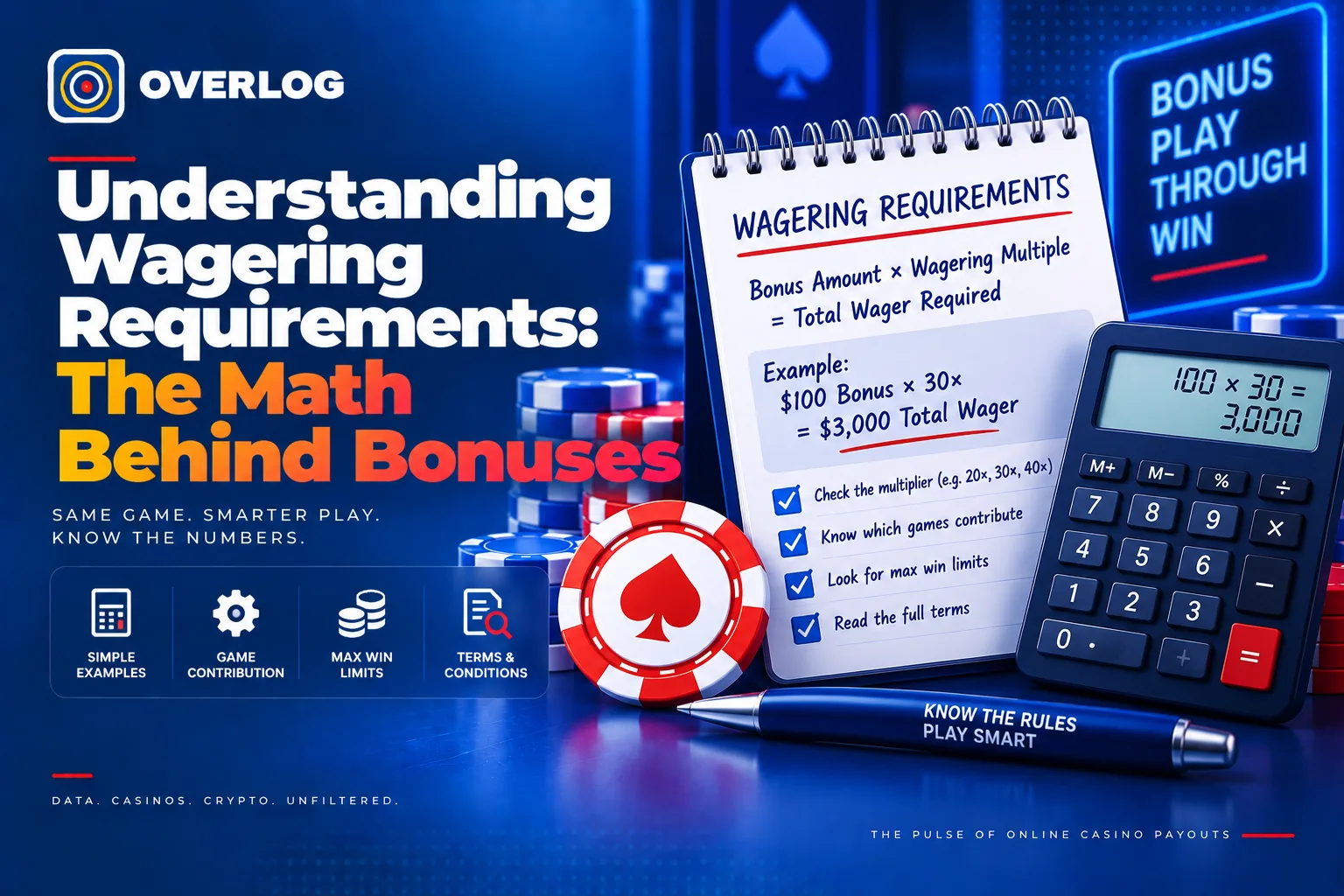
The basic math
Wagering multiplier × amount subject to wagering = total bets required.
Example: 35x wagering on a £100 bonus = £3, 500 in bets. Two variables to watch:
- Is the multiplier applied to bonus only, or to bonus + deposit?
- What counts as "bet", does every spin count toward the total, or only qualifying-game spins?
The difference between "35x bonus only" and "35x deposit + bonus" doubles the requirement. Same-looking offer, twice the work.
The true cost of wagering
Every bet at a casino has an expected value equal to the game's edge. On a slot with 96.5% RTP, every £1 bet has an expected value of -£0.035 (a loss of 3.5p per pound bet, on average).
Applied to £3, 500 in required wagering: 3, 500 × 0.035 = £122.50 expected loss to clear the bonus.
If your bonus is £100, you're expected to lose more clearing it than the bonus is worth. That's negative expected value even before variance and bonus terms kick in.
When a bonus is positive-EV
Positive expected value requires: bonus value > expected wagering losses. Reduces to:
Bonus × (1 − house edge × wagering multiplier) > 0
For a slot with 96.5% RTP (3.5% edge), the crossover point is roughly wagering multiplier = 1 / house edge = 28.5x. Anything below 28x on that slot is positive expected value. Above 28x, the house wins on average.
| Wagering multiplier | Expected loss (£100 bonus, 96.5% RTP) | Net expected value |
|---|---|---|
| 25x | £87.50 | +£12.50 |
| 30x | £105 | -£5 |
| 35x | £122.50 | -£22.50 |
| 40x | £140 | -£40 |
| 50x | £175 | -£75 |
The math is why the "up to 50x wagering" offers are so common, they're safely profitable for the casino.
Variance and completion odds
Expected value describes the average over many attempts. Any single attempt varies. High-volatility slots (Nolimit City, Push Gaming's big hitters) can bust your bankroll on the way to £3, 500 in wagering, or hit a huge win that lets you clear it easily.
Rule of thumb: lower-volatility slots (Big Bass series, Sweet Bonanza on lower stake) give you the best chance of actually completing the wagering with your bonus intact. Higher-volatility slots have wider outcome ranges but the same average result.
If you have to complete wagering, medium volatility is the sweet spot. If you can quit any time, high volatility with an early stop-win rule can beat the expected-value math on the upside.
Practical strategy
Four rules that beat most bonus play:
- Filter for < 30x wagering on bonus only, no cashout cap. Skip everything above.
- Choose 96%+ RTP slots that contribute 100%. This maximises your expected-value per bet.
- Bet at 40-60% of the max-bet cap. Fast enough to finish, safe from an accidental over-cap.
- Set a hard stop-loss at 50% of deposit + bonus. If variance goes against you, cut and move on.
Under these rules, positive-EV bonuses are rare, maybe 1 in 8 offers you'll see. That's fine. It just means being picky.
Frequently asked questions
Does a slot's RTP change the wagering math?
Yes, directly. A 97.5% RTP slot has half the house edge of a 95% RTP slot, so the same wagering multiplier costs half as much to clear on average. Filter for high-RTP slots when wagering.
Is it worth using a bonus if I mostly play blackjack or roulette?
Usually no. Table games contribute 5-20% to wagering, meaning you have to bet 5-20x more to clear the same requirement. The math is almost always -EV. Table game bonuses exist but are rare and specialist.
Can I lose money faster with a bonus than without one?
Yes, because wagering forces high volume through the casino edge. If you don't want to clear the wagering, sometimes the best play is to skip the bonus entirely, deposit smaller, and control your session yourself.

Amelia Foster
Bio coming soon. Independent, no paid placements, real deposits and stopwatch-timed payouts.
About the desk ›